

- Course Description
 The course is an intensive graduate-level course, 2.5 hours every week for three months. This course provides Early Career Researchers (ECRs) with a comprehensive understanding of electoral governance in Nepal while simultaneously strengthening their research skills and methodological capacity. The course explores the political, legal, institutional, and social dynamics that shape electoral processes in Nepal’s democratic system. Participants will examine topics such as the legal framework governing elections, the role of political parties, campaign finance, voter inclusion, digital technologies in elections, and mechanisms for dispute resolution and accountability.
Alongside the thematic exploration of electoral governance, the course equips participants with practical research competencies, including literature review, qualitative and quantitative research methods, hypothesis building, sampling techniques, data analysis, and ethical considerations in research. Through case studies drawn from previous elections in Nepal, participants will learn to critically analyze electoral systems and develop evidence-based research projects.
The course will be facilitated by young and experienced researchers, governance experts, social activists, and scholars. Each participant will be assigned a mentor from a group of facilitators. The facilitators serve as guides or mentors for the theoretical and practical aspects of research and presentation skills. The course ultimately aims to enable Early Career Researchers to produce rigorous research that contributes to democratic governance, transparency, and electoral integrity in Nepal.
- Objectives of the Course
- Build foundational knowledge of electoral governance in Nepal, including its legal, institutional, and political frameworks, and the key challenges affecting democratic processes.
- Strengthening the research and analytical capacity of ECRs by introducing essential research concepts, methodologies, and tools relevant to governance and electoral studies.
- Enable participants to design and conduct evidence-based research on electoral processes, contributing to policy analysis, civic engagement, and democratic reform in Nepal.
- Methodology of the Course
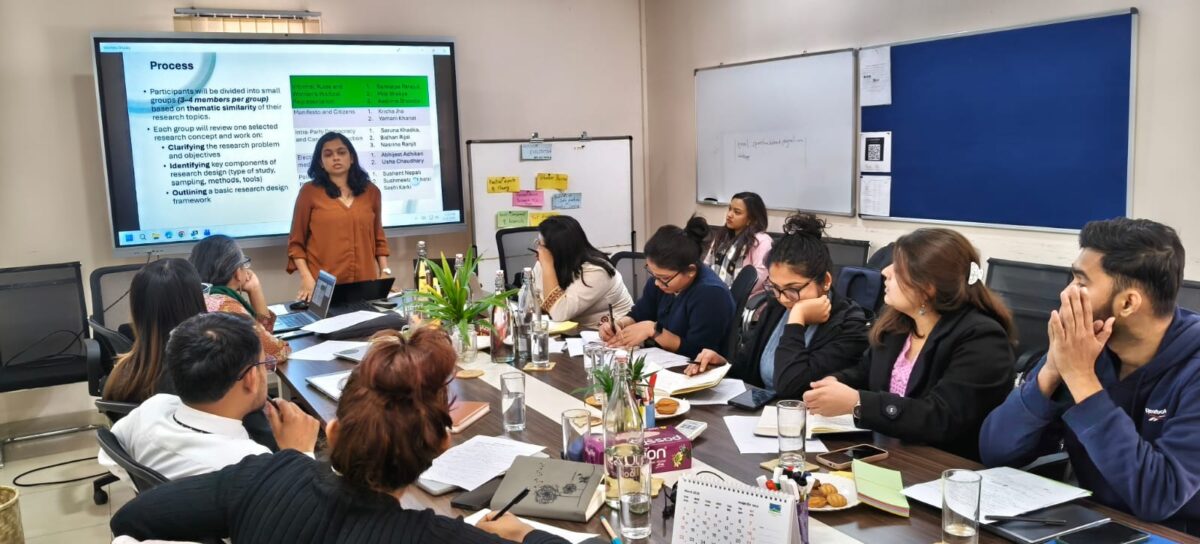
The course uses a participatory and practice-oriented approach that combines theoretical learning with applied research exercises. Teaching methods include lectures, facilitated discussions, case studies, group work, and hands-on research activities. Sessions introduce key topics such as electoral governance, legal frameworks, political parties, campaign finance, and digital influences on elections, followed by interactive reflection on Nepal’s electoral experiences.
Participants engage in peer discussions, collaborative research, and instructor feedback throughout the workshops. Practical exercises include developing research questions, conducting literature reviews, analyzing policy documents, mapping informal political networks, and assessing social media content for misinformation. The course also includes group presentations and peer review, and concludes with participants preparing at least a research report on an electoral governance topic, applying the theoretical and methodological tools learned during the program.
- Course Policy
The research workshop is a central component of this training program. To successfully complete the workshop, participants are expected to attend all sessions regularly and actively engage in discussions and group activities. Meaningful participation will depend on completing assigned readings and tasks before each session. Discussions and interactions during the workshop should remain respectful, constructive, and collaborative. Participants’ engagement, quality of contributions, and timely completion of workshop assignments will be considered in the overall evaluation.
The workshop does not rely solely on textbooks. Participants will receive handouts, policy documents, and access to online research articles. Additional materials such as selected readings, podcasts, and videos may also be provided to support learning.
All written work produced during the workshop must be original. Participants may not submit work that has already been presented in another course or program without prior approval from the facilitator. If external materials are used, all information, data, and ideas must be properly cited. Participants are encouraged to seek feedback from peers to improve their writing, research design, and analytical arguments; however, all submitted work must remain the participant’s own.
All participants are expected to maintain academic integrity and ethical research practices. Plagiarism, including the use of materials without proper citation or presenting another person’s work as one’s own, will be considered a serious violation of workshop ethics and may lead to disciplinary action by the organizers.
By the end of the workshop, participants are expected to complete all assigned tasks and maintain an average score of at least 75 percent. Participants whose performance falls below this threshold may be required to seek additional consultation with the facilitator to improve their work.
- Course Evaluation Structure
| Description | Weight |
| Question–answer assignments based on the course | 20 |
| Preparation of one research report for publication | 50 |
| Effective participation in class discussions | 20 |
| Peer feedback | 10 |
| Total | 100 |
6. Selected Fellows for 2026
| Thematic area of research | Researchers | Mentors |
| Informal Rules and Women’s Political Representation | 1. Sankalpa Parajuli,
2. Mila Shakya 3. Aashma Bhandari |
Kailash Rai |
| Manifesto and Citizens | 1. Kricha Jha
2. Yamani Khanal |
Dinesh Kafle |
| Intra-Party Democracy and Candidacy Selection | 1. Saruna Khadka,
2. Bidhan Rijal 3. Nasrina Ranjit |
CP Aryal |
| Election and AI/social media | 1. Abhijeet Adhikari
2. Usha Chaudhary |
Binita Nepali |
| Political Representation of PWDs | 1. Sushant Nepali | Shiva Hari Gyawali |
| Youth in Politics | 1. Sushmeeta Chhetri
2. Sashi Karki |
Shiva Hari Gyawali |
Note: This project is supported by International IDEA, Nepal.

Discussion about this post