

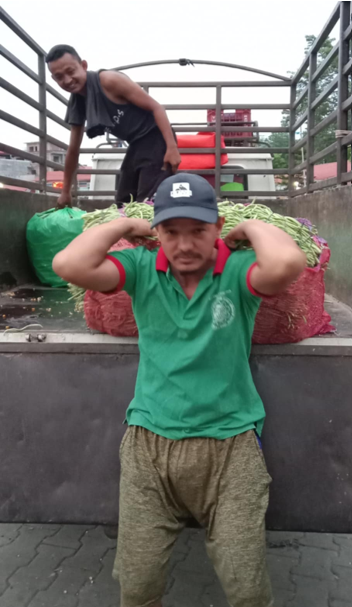
My name is Om Lal Thing. I’m originally from Makwanpur, but these days, I live and work in Chitwan as a daily wage worker, loading and unloading vegetables at the Sabji Mandi. Life in the informal sector is tough; there is no job security, no fixed salary, and definitely no safety net.
Last year, Samari Utthan Sewa came to our working area to form a group of informal sector workers. They aimed to advocate for the rights and security of workers like us. They discussed the importance of building unity and strength among workers and provided orientation and support to help us access social security schemes and information about the Social Security Fund (SSF). Since there were more than 80 informal sector workers at the Sabji Mandi, two groups were formed, and I became the chairperson of the Vegetable Workers Group.
After the formation of our group, Samari began providing orientation and information about the Contributory Social Security Fund (SSF), particularly for informal sector workers. They explained that if workers contribute 20.37% of a defined basic salary amount, and if the local government contributes 9.37%, we could enroll in the SSF and enjoy social protections such as health benefits, maternity protection, and pensions. Initially, we were confused about the enrollment process since we don’t have employers. However, Samari clarified that we could enroll in the SSF by contributing ourselves to secure our future.
At first, fifteen of us were ready to enrol in the SSF. Samari supported us in obtaining a recommendation from Bharatpur Metropolitan City, which had suggested we get a recommendation letter from our hometown. Thanks to their coordination, we were successfully enrolled in the SSF, and I received my SSF card. Honestly, I didn’t think much about it after that until an emergency struck my home.
In May, my wife fell seriously ill. When I took her for a check-up at Chitwan Medical College, the doctor informed us that she needed surgery for gallstones. I scheduled the operation but managed to gather only Rs. 25,000 for the day of the procedure, borrowing from relatives and friends, with no clear idea of how we would cover the hospital costs. I was terrified.
Initially, I was nervous about how the payment process with the SSF card would work. I kept wondering, “Will it really help? What if the support doesn’t come in time?” However, once the hospital registration began, I was pleasantly surprised to find that I had to pay much less than the regular registration charges. There was another patient undergoing the same type of operation, but they had to pay a significantly higher amount. Because I was enrolled in the SSF, I was charged less at every stage of the process. The total cost of my wife’s operation exceeded Rs. 106,000, but I only had to pay Rs. 13,500 in total, with the rest covered by the SSF.
When I left my house for the hospital, I was extremely tense, worried, and panicked. However, after the operation was completed and the costs were managed, my entire family felt a tremendous sense of relief and happiness. I am truly grateful to Samari Utthan Sewa for encouraging us to enroll in the SSF. If I hadn’t joined, I would have had to take a loan of over one lakh rupees, which would have created even more struggles for my family.
After this experience, I have started actively informing and encouraging other informal sector workers to enroll in the SSF. It is a highly beneficial scheme for low-income workers like us, and I believe it can provide real security in times of crisis.




Discussion about this post